

 العربية
 English
 français
 Deutsch
 español
 中文
中文
Many facilities know they have a power factor problem. The utility bill shows penalties, transformers run hot, and production equipment overheats. But the obvious solution—installing reactive power compensation directly on the medium-voltage side—can be expensive, complex, and difficult to maintain.
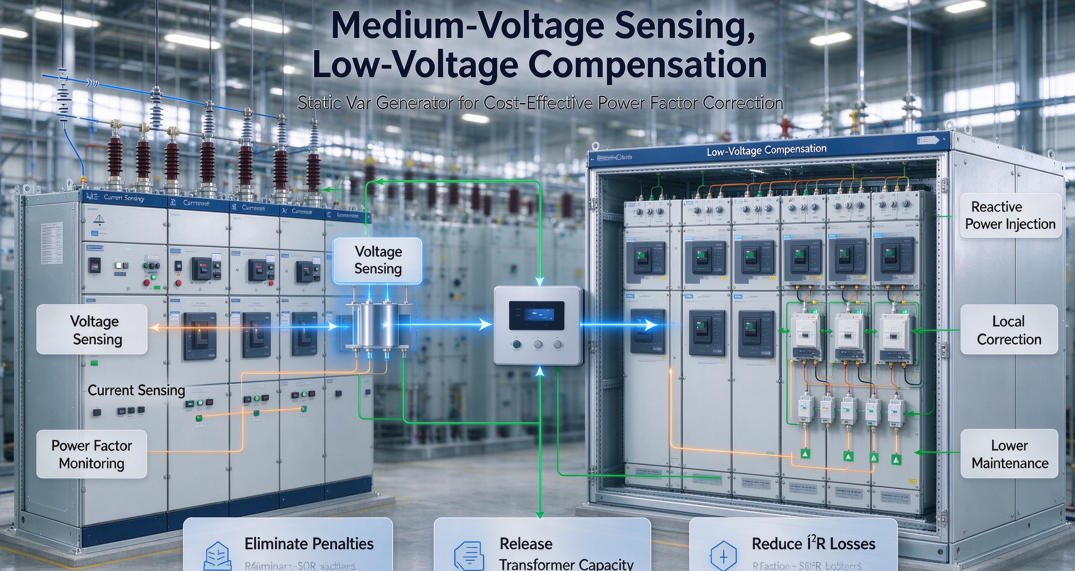
Static Var Generator changes the economics with a smarter architecture: sense power quality on the medium-voltage side, then compensate reactive power on the low-voltage side. The result is accurate, fast, and cost-effective power factor correction without the cost and complexity of medium-voltage compensation equipment.
The medium-voltage side is the main connection point between the facility and the grid. It reflects the overall power quality of the entire system, not just one local low-voltage feeder. If SVG only measures low-voltage parameters, it may compensate based on incomplete data and cause over-compensation or under-compensation.
SVG with medium-voltage sensing uses high-precision sensors to monitor voltage, current, and power factor at the main connection point. This gives the controller a complete, real-time picture of system demand. The low-voltage compensation modules then act on precise commands to inject or absorb the exact reactive power needed.
In simple terms, medium-voltage sensing is the eyes. Low-voltage compensation is the hands. Together, they deliver accurate correction at lower cost.
Lower Equipment Cost
Low-voltage compensation modules are less expensive to manufacture and require lower technical specifications than medium-voltage compensation systems. Medium-voltage sensors are mature, reliable products. This architecture reduces capital expenditure while maintaining high accuracy.
Avoid Utility Power Factor Penalties
A facility with a power factor fluctuating between 0.82 and 0.88 often pays penalties every month. SVG raises the power factor consistently above 0.95, eliminating those charges and often earning a reactive power credit.
Release Transformer Capacity
Poor power factor consumes transformer capacity without delivering useful work. By correcting reactive power, SVG frees capacity for active power. In many cases, this avoids the need for transformer upgrades or additional capacity charges.
Reduce Energy Losses
Reactive current flowing through cables and transformers creates heat and wasted energy. Accurate low-voltage compensation reduces current flow, lowering I²R losses and improving overall system efficiency.
Extend Equipment Life
Voltage fluctuations and reactive power imbalance cause motors, welding machines, and transformers to overheat. SVG stabilizes voltage and reduces stress on equipment, extending service life and lowering maintenance costs.
Safer and Simpler Maintenance
Low-voltage compensation modules are easier and safer to service than medium-voltage equipment. Maintenance personnel do not need to work on high-voltage compensation hardware during routine checks, reducing downtime and safety risk.
A medium-sized automotive parts factory in Guangdong had many inductive loads, including motors and welding machines. The power factor on the medium-voltage side fluctuated between 0.82 and 0.88, and production equipment overheated frequently. The factory installed SVG with medium-voltage sensing and low-voltage compensation. The system measured the overall power quality at the main connection point and corrected reactive power locally on the low-voltage side. This avoided the cost of medium-voltage compensation equipment while improving power factor accuracy and reducing equipment stress.
Q: Why not simply compensate on the medium-voltage side?
A: Medium-voltage compensation equipment is more expensive, larger, and harder to maintain. It also requires higher insulation and safety standards. SVG with medium-voltage sensing and low-voltage compensation achieves accurate system-level correction using lower-cost low-voltage modules. The sensing point is at medium voltage, but the correction happens where it is cheaper and safer to install and service.
Q: How much can a customer realistically save?
A: Savings depend on load profile, tariff structure, and current power factor. Typical savings come from eliminated power factor penalties, reduced transformer losses, released capacity, and lower maintenance costs. For a facility running at 0.82 to 0.88 power factor, correcting above 0.95 can produce significant monthly savings and often pays back the SVG investment within a few years.
Q: What should be checked before designing this SVG solution?
A: A power quality audit should confirm medium-voltage sensing accuracy, load fluctuation range, harmonic spectrum, transformer impedance, and the maximum reactive power deficit. Sensor error for voltage and current should generally be within ±0.5%. The SVG capacity should be sized with a margin based on real reactive demand, not only on the existing capacitor bank rating.
Medium-voltage sensing with low-voltage compensation is a practical way to solve reactive power problems without paying for medium-voltage compensation hardware. SVG delivers accurate detection, fast response, and lower total cost. It eliminates penalties, releases transformer capacity, reduces losses, and protects equipment—all while keeping installation and maintenance simple.
If your power factor is unstable and your transformer is running hotter than it should, please contact us sales@yt-electric.com this architecture may be the most cost-effective solution for your facility.



 دعم شبكة IPv6