

 العربية
 English
 français
 Deutsch
 español
 中文
中文
Capacitor cabinets in a 400 V mill keep failing after the plant commissions an AHF. Handover records show THDi at the PCC inside the IEEE 519 envelope. Eighteen months later the cabinet trips on overtemperature, residual harmonic current returns, and another capacitor can ruptures.
AHF and SVG maintenance is not optional housekeeping. Dust on heat sinks, blocked inlet filters, and untracked DC-link aging raise semiconductor junction temperature until harmonic mitigation and reactive power compensation fall out of spec.
The converter rarely loses its control code overnight. It leaves the thermal window selected for the IGBT or SiC MOSFET modules, then derates current, cuts switching frequency, and stops holding Total Harmonic Distortion.
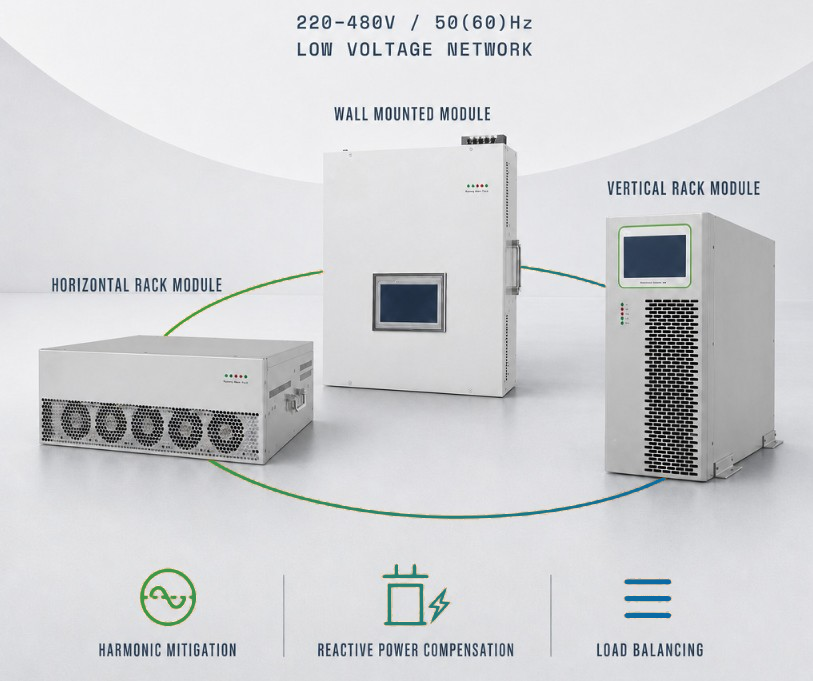
An Active Harmonic Filter measures load or source current, extracts the harmonic component, and injects an opposing current through IGBT or SiC MOSFET bridges. An SVG injects dynamic reactive current for power factor correction and voltage stabilization. Both dump switching and conduction loss into a heat sink.
Junction temperature governs wear more than nameplate amperes. As a working Arrhenius estimate, each 10 °C rise in semiconductor temperature roughly halves expected life; treat that as an engineering rule of thumb, not a type-test result.
High THDi feeds the same loop from the load side. Harmonic current raises transformer copper loss through higher RMS heating and increases iron loss through additional flux harmonics, so the room and cabinet both run hotter.
A 3-level topology reduces device voltage stress and dv/dt compared with a 2-level bridge on the same DC bus, which cuts switching loss and thermal cycling. If SPWM switching frequency then drops to protect an overheated module, compensation bandwidth falls and residual THDi returns.
A design that delivers full current at 40 °C often needs current derating for 45 °C ambient temperature full-load duty. Zero-sequence current on a 3P4W feeder adds a second heating path: triplen harmonics sum in the neutral and overheat four-wire AHF modules if the CT zone is wrong.
Maintenance does not mean opening every module on a blind calendar. It means proving that the cooling path, measurement chain, DC bus, and protection settings still keep the converter inside its thermal envelope.
Inspect inlet filters, fans, and heat-sink fins first. A clogged filter raises inlet air temperature and produces the same junction-temperature rise as a hotter ambient.
Verify CT ratio, polarity, and zone after any switchgear change. Reversed or drifted CTs make an AHF or SVG under-compensate or inject into the wrong zone, which raises RMS current without correcting THDi.
Measure DC-link capacitor ESR and ripple against the manufacturer’s service limit. Rising ESR heats the dielectric and ends in DC-bus undervoltage trips or IGBT desaturation. Confirm firmware, current limits, and generator or bus-tie modes after any network change, and log inlet temperature, module temperature, residual spectrum, and power factor.
|
Item |
Capacitor bank |
Passive filter |
Active Harmonic Filter |
SVG |
|
Duty |
Fixed reactive power |
Tuned harmonic shunt |
Harmonic current injection |
Dynamic reactive compensation |
|
Wear |
Resonance, can swelling |
Detuning from aging |
Junction-temperature cycling, clogged air path, DC-link ESR |
Same thermal path; hunting on weak sources |
|
Inspect |
Capacitance, fuses, reactor heat |
Tuning, reactor heat |
Air path, fans, CTs, DC-link capacitors, residual THDi |
Air path, CTs, reactive current limit |
|
If neglected |
Repeated can failure, PF penalty |
Off-tune, THDi rebound |
Overtemperature trip, derating, THDi rebound |
PF penalty return, voltage flicker |
|
Interaction |
Resonates with VFD harmonics |
Overload near its notch |
Injects only what CTs see |
Fights a fixed capacitor bank |
A capacitor bank fails first when residual voltage distortion remains on the bus, because harmonic voltage drives excess capacitor current. SVG and AHF share the same wear path and still need a clean air path, a valid CT zone, and a DC bus inside its ripple limit.
Set the interval from dust, ambient temperature, and load cycling, not from a generic annual visit. A clean electrical room and a spinning mill do not load inlet filters at the same rate.
Keep 45 °C ambient temperature full-load as a hard check. If the room cannot hold the design inlet temperature, add cooling or apply the published current derating.
Do not run a fixed capacitor bank and an SVG on the same measured bus without a defined control hierarchy. The SVG will hunt while the capacitors switch, which raises extra RMS current and thermal stress.
|
Site condition |
Duty to verify |
Cooling / control check |
Typical interval |
|
Clean LV room, ≤40 °C |
Full current if inlet air matches design |
Filters, residual THDi, PF, CT polarity |
Filters 6 months; inspection 12 months |
|
45 °C ambient or poor ventilation |
Apply published current derating |
Fin cleaning, inlet/outlet ΔT, thermal alarms |
Filters 1–3 months; thermal audit each summer |
|
Dusty mill, textile, cement, mine |
Same duty plus fan and seal corrosion |
Filter replacement, IP seals, connector torque |
Filters monthly to quarterly |
|
VFD feeder with capacitor bank |
AHF current ≥ measured harmonic amperes, not THDi % |
Air path before re-energizing caps; staged capacitor control |
After each capacitor failure and each quarter |
|
Generator, UPS, or 3P4W triplen load |
Recalculate current limit; check four-wire/neutral rating |
Mode set-points, CT zone, neutral temperature |
At each mode change and PQ survey |
Use measured harmonic amperes to confirm AHF rating, not a single THDi percentage. THDi rises at light load because the denominator is fundamental current, so a high percentage can still mean a small ampere error. Size SVG from the reactive current needed for contractual power factor and voltage support during the largest load step, then confirm cooling can reject that loss in the actual ambient.
A representative industrial site in India supplies clustered VFDs from a 415 V, 50 Hz board. The plant had already replaced capacitor cans more than once and paid a utility penalty for power factor below the contractual threshold.
Measured symptoms included capacitor swelling, feeder heating, and an AHF overtemperature trip during the afternoon peak. A typical operating point showed double-digit current THDi at the main bus and lagging power factor outside the utility band.
The load mix was six-pulse drives with an automatic capacitor bank on the same LV bus. CT polarity was correct, but inlet filters were blocked and two DC-link groups showed ESR above the service limit.
The working plan restored airflow, replaced the aged DC-link groups, applied the 45 °C current derating for summer peaks, and interlocked capacitor steps against the converter control zone. Overtemperature trips then stopped under the same production pattern. Residual THDi at a comparable operating point typically returns to a single-digit band when the AHF can deliver rated harmonic current; reconfirm those values on site.
Select AHF current from simultaneous harmonic amperes at the CT zone, including diversity, not from nameplate kVA or a single THDi reading. Select SVG current from the reactive ampere gap to the contractual power factor plus voltage-support current on the worst load step.
Parallel connection allows much inspection with the converter isolated at its own breaker while the plant stays on supply. CT, cable, or bus work still follows the site LOTO rule and may need a feeder outage.
Service the air path, fans, and filters on an interval set by dust and ambient temperature. Recheck CTs, DC-link capacitors, residual THDi, power factor, and thermal logs at least twice a year, and more often in mills or 45 °C rooms.
They can, if the CT zone, reactive hierarchy, and source-impedance modes are defined. A fixed capacitor bank on the same bus needs staged control so the SVG does not hunt, and generator or UPS mode needs a separate current limit.
AHF and SVG maintenance keeps harmonic mitigation and reactive power compensation inside the thermal and measurement limits that determine equipment lifetime. A clean air path, a valid CT zone, a DC bus within ripple limits, and a documented 45 °C derating prevent the cycle in which the converter derates, THDi returns, and capacitor cans fail again.
Send YT Electric the single-line diagram, voltage, measured harmonic amperes, power factor, ambient, and existing capacitor or generator modes. The Power Quality Division will map inspection intervals to that duty.
Explore YT Electric product specifications and application guidance: https://www.ytelect.com/blog/guide-to-selecting-active-harmonic-filters_b321
Reference: IEEE 519-2022, IEEE Standard for Harmonic Control in Electric Power Systems: https://standards.ieee.org/ieee/519/10677/
Need a site-specific solution? Share your single-line diagram, load list, measured power factor, THDi/TDD data, and ambient conditions with YT Electric. Our sales engineers can review the data and prepare a technical proposal



 دعم شبكة IPv6